I am an independent teacher (not in the employment of a dance
studio) and teach out of many rental studios in Manhattan.
I book my own lessons directly so call me rather than the studio.
To contact me email
or telephone (631) 875-3764 for an appointment. Private lessons
may be arranged in your home (providing space allows) and small
group classes (four students minimum) can be arranged as well
at various venues.
 A
quick example of a teaching concept:
A
quick example of a teaching concept:
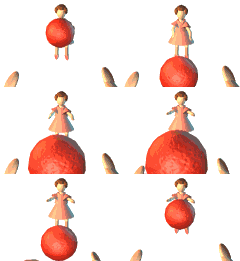
Stand up and take an ordinary rubber ball
(ie: tennis ball) and listen to a selection of music. Count out the
mini phrases of eight. Try to make the ball contact the floor
on the musical count of "1" on each mini phrase.
As
you gain a little accuracy you will notice an interesting effect:
You must prepare your drop of the ball with a movement prior
to the count of one to have it arrive at it's destination on time.
 Now
try this count "+a1+a2+a3+a4+a5+a6+a7+a8" (the rolling count) and
notice how your timing and accuracy are increased with a preparation
that occurs
on the +a PRIOR to the count of one. Now visualize an Orchestra
Conductor lifting their arm with a breath PRIOR to starting the piece
of music, that IS valid metered timing. To teach someone
how to move into a space on the desired count you must explain
the prior (preparation) movements as well. All movement starts
from your "Center" in a controlled manner.
Now
try this count "+a1+a2+a3+a4+a5+a6+a7+a8" (the rolling count) and
notice how your timing and accuracy are increased with a preparation
that occurs
on the +a PRIOR to the count of one. Now visualize an Orchestra
Conductor lifting their arm with a breath PRIOR to starting the piece
of music, that IS valid metered timing. To teach someone
how to move into a space on the desired count you must explain
the prior (preparation) movements as well. All movement starts
from your "Center" in a controlled manner.
Consider the part of your body that forms
a continuous band, front and back, between the bottom of your
rib cage and the line across your hipbones, this is your "center"
(physically speaking). Correct technique in dancing requires
you to maintain control through a strong, stretched and supple
center. The benefits of this training are a trimmer waist and
flatter belly; it means better posture and a more regal carriage.
A properly developed center supports all movement and will mean
less fatigue and will lower your incidence of back pain and injury
in everyday duties away from dance.
Concentration, control, centering, economical
flowing movement, precision and breathing are the cornerstones
of good technique. Dance "figures" and "patterns"
are just suggestions, good technique creates creative dancing
from your soul in any dance.
Who taught me?
Dance lessons are
something many Brides and Grooms think about as they prepare for
their wedding - especially for the first dance at the reception. The
decision to take dance lessons is different for each couple. The
main thing is to get to a point where you’re comfortable dancing in
front of others. At first the thought of dancing alone - in front of
everyone - can be a little intimidating. So, if you’re not
comfortable dancing, but still want to have a first dance it’s
probably a good idea to take a few lessons.
Sometimes there’s a bit of a hurdle to overcome to
get started with dance lessons. I’ve had couples that wanted to have
some fun with their first dance and I’ve gone so far as to working
out a specific routine for their first dance. I worked with a very
nice couple (Jim and Diane) that did exactly that. The groom was not
much of a dancer. In fact, he wasn’t a dancer at all…and his friends
knew it! So, here’s what they did…
Jim and Diane worked out a schedule to take dance
lessons to prepare for their first dance together. They decided on
the song “You and I” and worked to develop a great little single
rhythm waltz routine. They came in for their Grand Entrance and went
straight into their first dance. To say the least, everyone was
surprised and cheered as they danced! Jim and Diane had a great time
with their first dance, and their friends and families loved it too!
Most times I try to teach a couple how to move
together simply with the leader actually leading directions to the
follower, this way if they forget their routine or dance moves, they
can still dance and no one will know the better of it. The added
advantage of this approach is that the couple can dance together for
the rest of their lives, not just for one day. Dancing is a
wonderful recreation and a chance to share time together.
©1994 - 2012 Music
For Dancing

Check for availability for our services:




 Left Feet Made
Rightsm
Left Feet Made
Rightsm